WordPress → Payload · Field guide
Turning WordPress sites into Payload systems.
It's the work we do best: taking a WordPress site that's outgrown itself and rebuilding it as a modern, typed, scalable Payload system — without losing your content, your URLs, or your search rankings.
What we actually do
Plenty of studios build Payload sites. We specialize in one thing: converting existing WordPress sites into Payload systems.
It's not a coincidence. The practices that came to us on WordPress — pediatric care and clinical nutrition among them — were rebuilt exactly this way. That pattern is now the center of how we work, because the hardest part of a migration isn't the new stack. It's understanding the system you already have and carrying its value forward cleanly.
The breaking point
Why teams outgrow WordPress.
Plugin sprawl
A dozen plugins each want updates, and any one of them can break the site or open a hole. The stack becomes a liability instead of an asset.
Security and upkeep
WordPress is the most attacked CMS on the web. Constant patching, hardening, and version anxiety pull time away from the actual business.
A performance ceiling
Page builders and plugin overhead add weight that caching can only hide for so long. Core Web Vitals and real speed stay stuck.
A rigid content model
Custom fields bolted onto posts and pages get brittle fast. The data never quite matches how the business actually thinks.
The upgrade
What Payload gives you instead.
A code-first schema
Your content model lives in version-controlled TypeScript, designed around the real business, not forced into posts, pages, and a pile of meta fields.
Typed content, end to end
Generated types connect the admin, the API, and the front end, so a content change can never quietly break a page.
One app, one stack
The CMS and the Next.js front end live in the same codebase. No REST round-trips between disconnected systems, no theme-vs-plugin tug of war.
Real ownership
No license treadmill, no lock-in. You hold the code, the data, and the deployment. It stays a system you can keep evolving on your own terms.
The method
A calm, repeatable path off WordPress.
A migration goes wrong when it's treated like a file transfer. We treat it as a system rebuild with the business domain at the center.
- 01
Discovery and content audit
We inventory every page, post type, custom field, media library, and URL. Then we decide what to keep, merge, or retire before any code is written.
- 02
Model the business domain
Services, locations, practitioners, resources, and reusable blocks become deliberate Payload collections and relationships, not generic posts.
- 03
Build the system
Next.js, Payload, TypeScript, the design system, forms, search, and editorial workflows are assembled into a maintainable foundation.
- 04
Migrate content, repeatably
A scripted, dry-run-friendly import moves WordPress content into the new model, idempotent and rerunnable, so the cutover is calm, not chaotic.
- 05
Preserve SEO with redirects
Every old URL is mapped to its new home with 301 redirects, structured data, and clean metadata, so hard-won search equity carries over.
- 06
Launch and support
We handle the cutover, watch performance and indexing after go-live, and stay close to the stack as the system grows.
Proof
WordPress sites, rebuilt on Payload.
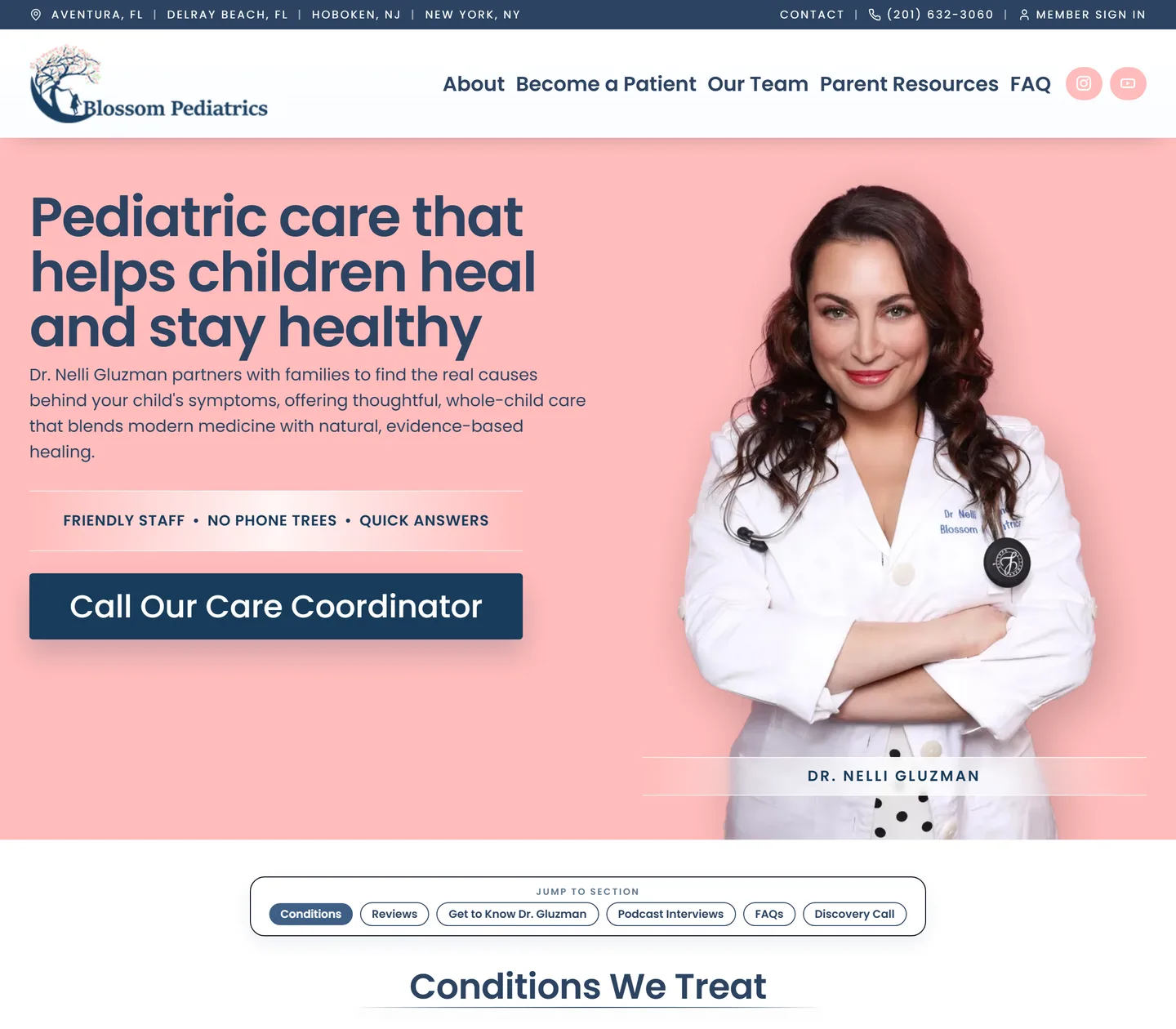
Blossom Pediatrics
A plugin-heavy WordPress site rebuilt into a fast, trustworthy pediatric web system with a maintainable content model.
Read the case study
The Harvest Method
A clinical nutrition practice moved off WordPress into a Payload system with program funnels and reliable intake flows.
Read the case studyWhat changes
What you leave behind, and what you gain.
On WordPress
- Updates and security patches every week
- Plugins fighting your theme for control
- Custom fields bolted onto posts and pages
- Performance capped by page-builder bloat
- Licenses and lock-in you keep renting
On Payload
- A typed schema you own and version
- One Next.js + Payload codebase, end to end
- Content modeled around the real business
- Fast, server-rendered pages built for Core Web Vitals
- Scheduled cron jobs and CI workflows that sync vital data automatically
- Full ownership of code, data, and deployment
Questions teams ask
WordPress to Payload, answered.
Will I lose my Google rankings when I move off WordPress?
Not when the migration is done properly. We map every existing URL to its new location with 301 redirects, preserve metadata and structured data, and keep the content intact. The goal is for search engines to see an upgrade, not a brand-new site.
Can you migrate my existing WordPress content automatically?
Yes. We build a repeatable, dry-run-friendly import script that moves posts, pages, media, and custom fields into the new Payload content model. Because it's rerunnable, the final cutover is predictable rather than a one-shot risk.
Do I have to give up the WordPress admin my team is used to?
You move to the Payload admin, which we design around your actual workflow: clear fields, reusable blocks, drafts, and preview. Most teams find it calmer than a WordPress dashboard buried under plugin settings.
What if only part of my site needs to move?
We typically rebuild the system from the ground up because that's where Payload pays off, but the discovery phase decides what carries over, what's retired, and how to stage the transition so nothing important is lost.
Still on WordPress?
Tell us what your site does today, and what it can't do anymore.
We'll map a clear, low-risk path from your current WordPress site to a Payload system you actually own.
This is part one of an ongoing series on moving from WordPress to Payload. Next up: leaving WordPress without losing your Google rankings. More field notes and video walkthroughs are on the way.